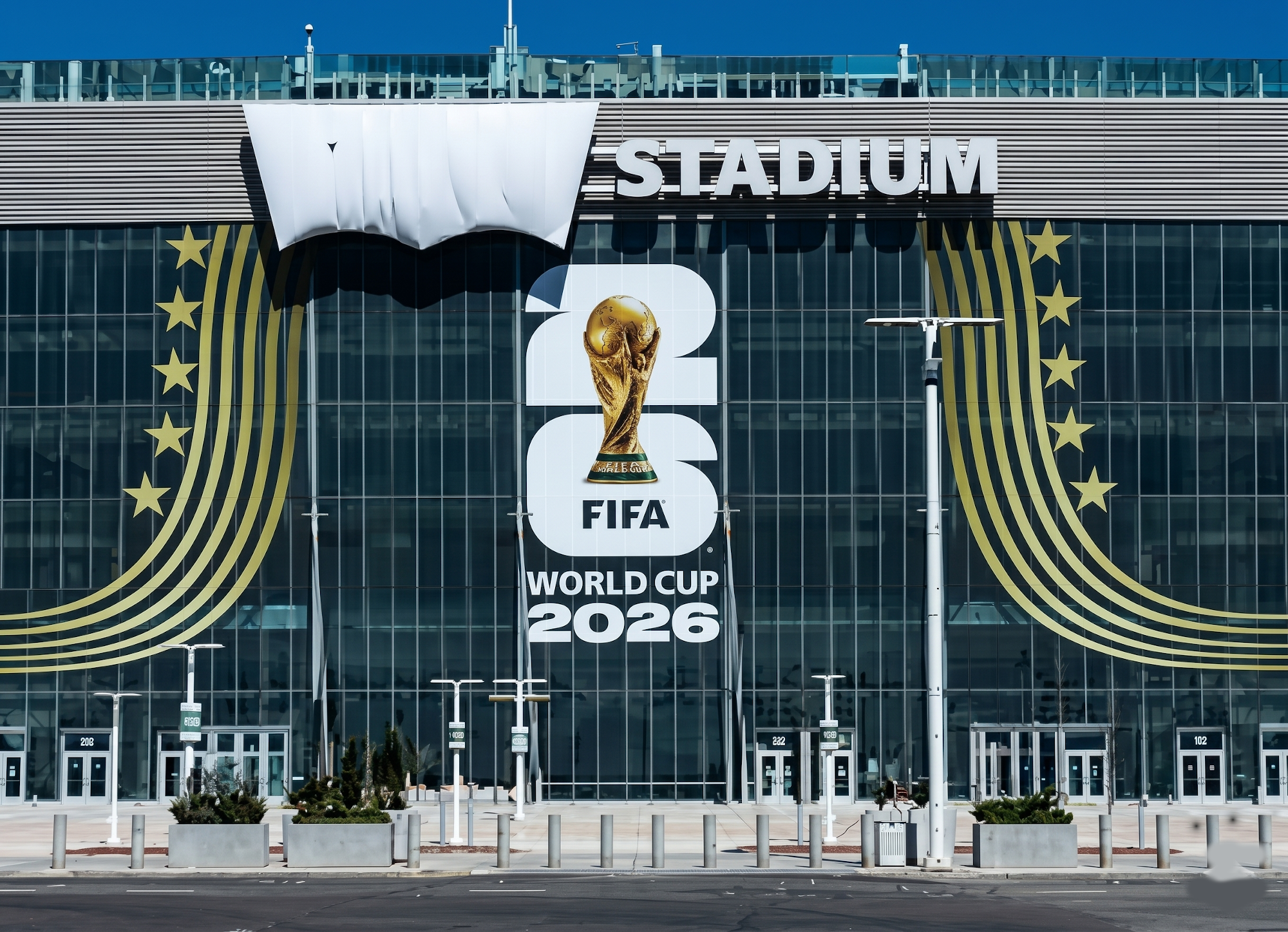
Every four years, the FIFA World Cup transforms stadiums into global stages. But along with the excitement comes a little-known rule that often forces some of the world’s biggest brands to temporarily disappear.
FIFA requires official tournament venues to remove or cover branding that conflicts with its own sponsorship agreements. Stadiums named after non-partner brands are often temporarily renamed, and logos are hidden from public view throughout the tournament to protect the exclusivity of FIFA’s commercial partners.
This means iconic venues effectively lose part of their identity for a few weeks.
But this wasn’t unique to Levi’s Stadium. Several major venues across North America were also temporarily renamed to comply with FIFA’s commercial regulations. Mercedes-Benz Stadium in Atlanta became Atlanta Stadium, Gillette Stadium in Foxborough, Massachusetts, became Boston Stadium, MetLife Stadium in New Jersey, which will host the World Cup final, became New York New Jersey Stadium, Hard Rock Stadium in Miami became Miami Stadium, AT&T Stadium in Arlington, Texas, became Dallas Stadium, and SoFi Stadium in Los Angeles became Los Angeles Stadium. Even Mexico City’s iconic Estadio Azteca, following its sponsorship agreement with Banorte, will be referred to as Mexico City Stadium for tournament purposes.
For most venues, these changes happen quietly in the background.
But instead of seeing this as a setback, Levi’s saw an opportunity.
When Levi’s Stadium was required to cover its famous logo ahead of the 2026 FIFA World Cup, the brand didn’t simply comply and move on. Instead, it leaned into the moment with humour.
Rather than replacing the logo entirely, Levi’s covered it with a simple white silhouette that unmistakably resembled the original shape. The message was subtle but effective: everyone knew exactly what was being hidden.
The brand then carried the joke onto its social media platforms, welcoming visitors to the stadium while embracing the temporary disguise. Even its Instagram profile adopted the same visual treatment by covering the Levi’s logo with a white silhouette.
What could have been an invisible moment became a viral one.
People began sharing screenshots, commenting on the creativity and applauding the brand’s sense of humour. Suddenly, a FIFA sponsorship restriction had become a marketing campaign without feeling like one.
And that is precisely what makes this such a fascinating case study in modern branding.
Turning limitations into opportunities
One of the biggest shifts in marketing over the past decade has been the move away from traditional advertising and towards cultural participation.
Today’s audiences are incredibly good at spotting forced advertising. They don’t necessarily want to be sold to, but they do enjoy participating in cultural moments. Brands that can insert themselves into those conversations authentically often generate far more attention than brands that simply buy advertising space.
Levi’s recognised that millions of people were already paying attention to the World Cup.
Instead of competing for attention, it inserted itself into a conversation that was already happening.
More importantly, it did so without appearing overly promotional.
That balance matters.
The most effective marketing today often doesn’t feel like marketing at all. It feels human.
By acknowledging the situation rather than ignoring it, Levi’s transformed a sponsorship restriction into an opportunity to strengthen its personality and reinforce its brand identity.
In some ways, the logo became even more recognisable while hidden.
People didn’t need to see the Levi’s name to know exactly who it was.
That is the power of strong brand equity.
In many ways, this is what marketing looks like in 2026: agility over perfection.
The most successful brands are no longer just campaign creators; they are cultural participants. They pay attention to what’s happening around them and respond quickly with content that feels natural, timely and human.
A lesson for small businesses
There is also an important lesson here for small businesses and emerging brands.
You do not need a FIFA-sized budget to replicate this approach.
The principle is simple: use moments that already have people’s attention.
Whether it’s a global sporting event, a trending social media conversation, a public holiday, an industry announcement or even a temporary inconvenience, every moment can become a branding opportunity if approached creatively.
Ask yourself:
- What conversation is everyone already having?
- How can my brand participate authentically?
- Can I add humour, insight or a fresh perspective?
- Can I turn a limitation into something memorable?
Often, the answer lies in embracing imperfection rather than hiding it.
Many brands instinctively try to minimise disruptions or pretend they don’t exist. Levi’s did the opposite. It acknowledged the situation, laughed along with its audience and invited people to be part of the joke.
That transparency created connection.
And connection is ultimately what drives modern marketing.
People may forget advertisements, but they remember brands that make them smile.
The age of agile marketing
Levi’s success also reflects a broader shift taking place across the marketing industry.
Brands are no longer just advertisers; they are storytellers, commentators and cultural participants.
Speed, creativity and authenticity have become competitive advantages.
A clever social media response can sometimes generate more impact than an expensive advertising campaign.
What Levi’s demonstrated was simple yet powerful: you don’t always need to own the space physically to own the conversation digitally.
The FIFA World Cup will eventually end. Stadium names will return, logos will be uncovered and sponsorship agreements will expire.
But the conversation Levi’s created will likely outlast the tournament itself.
Because the real victory wasn’t preserving its logo.
It was reminding people that even when a brand is technically hidden, it can still be impossible to ignore.
In an era where attention is one of the world’s most valuable currencies, the brands that win are not necessarily the ones that are seen the most.
They are the ones that know how to turn an obstacle into an opportunity.
Sometimes, disappearing for a moment is exactly what makes people pay attention.
And that may be Levi’s biggest marketing victory of all.
Sometimes, the best marketing doesn’t come from having the biggest logo in the room.
It comes from knowing exactly what to do when that logo has to disappear.