
For decades, fashion ran on a rhythm you could set a watch to. Designers set the trends, retailers planned around seasonal collections, and consumers more or less fell in line. That model is coming apart.
What’s shaping fashion now isn’t trend cycles so much as a tangle of forces working on the industry at once: climate change, artificial intelligence, economic pressure, shifting consumer expectations, and supply chains that have gotten a lot harder to predict. Put them together and you get an industry where the companies doing best aren’t necessarily the biggest – they’re the ones that can adjust.
McKinsey & Company and The Business of Fashion capture this in their State of Fashion 2026 report, describing an industry in “constant evolution,” where volatility isn’t a phase to wait out but the new baseline. Executives are increasingly planning around uncertainty rather than betting on things settling down.
Climate is changing what we wear – and how retailers operate
Climate change used to sit in the “environmental issue” column. Now it’s showing up on P&L statements.
Across Europe, extended heatwaves are pushing retailers to extend their summer ranges, lean harder into lightweight fabrics like linen and Tencel, and respond to a real jump in demand for breathable, heat-resistant clothing. Vogue Business reported Pinterest data showing sharp increases in searches for terms like “heatwave outfit” through 2026 – a small but telling sign of how consumer behaviour is moving alongside the climate itself.
It doesn’t stop at the clothes. Brands are also rethinking where and how they source – simplifying supply chains and looking at more localised manufacturing, partly to cut emissions and partly because shorter chains are just easier to manage when conditions keep shifting.
Climate adaptation, in other words, has quietly become a business strategy as much as a sustainability one.
Consumers are redefining value
Shoppers everywhere are still dealing with inflation and a higher cost of living. But rather than stepping back from fashion altogether, they’re getting pickier about where their money goes. The shift is less “buy less” and more “buy better.”
Retailers are competing more on quality, durability and how versatile a piece is – not just on who can discount fastest or churn out product quickest. That’s helped the middle market – brands offering elevated quality without luxury pricing – become one of the industry’s stronger growth stories.
Underneath it all is a change in how people think about value itself: less about the lowest price tag, more about whether something’s actually going to last and get worn.
Artificial intelligence is transforming retail behind the scenes
Most of the public conversation about AI in fashion has centred on generated imagery and marketing content. But the bigger impact is happening somewhere far less visible.
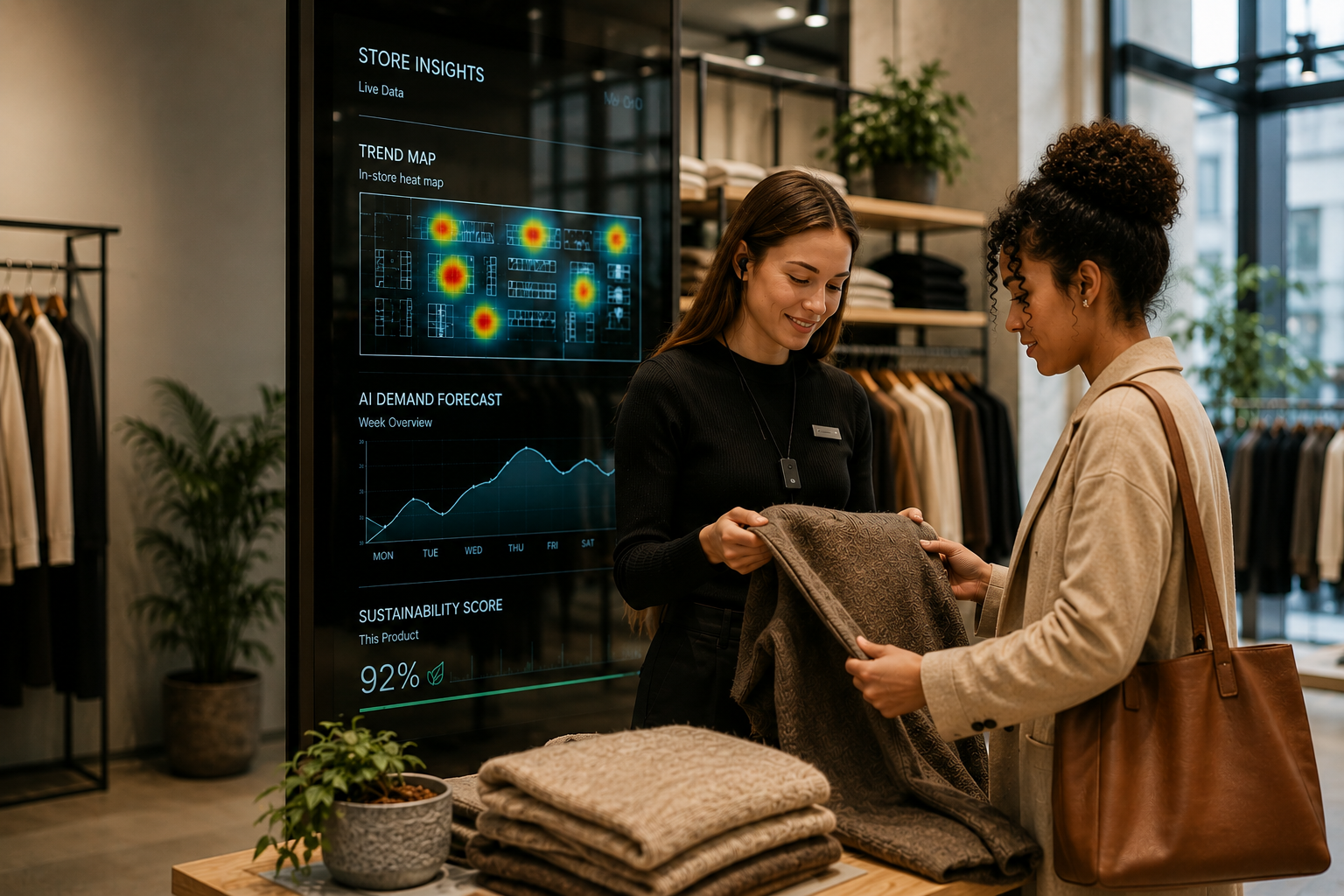
Retailers are using AI to forecast demand, fine-tune pricing, manage inventory and personalise the customer experience. McKinsey points out that analytical AI is helping retailers keep products in stock and understand their customers better, while generative AI is speeding up marketing and content production. Together, this lets retailers react faster to what customers actually want, without piling on operational overhead.
The real question for most retailers isn’t whether to adopt AI anymore – it’s how to fold it into the business without losing the human relationships that still make retail work.
Supply chains have become a strategic advantage
Years of geopolitical friction and shifting trade policy have changed how fashion companies think about sourcing. Chasing the lowest unit cost is no longer the whole strategy – brands are spreading their supplier base, investing in visibility across the supply chain, and trying not to lean too hard on any single region.
The State of Fashion 2026 report flags trade disruption as one of the industry’s biggest risks going forward, which is pushing companies to treat sourcing as something to actively manage rather than something to set and forget.
Supply chains used to be a back-office concern. Now they’re closer to a competitive edge.
Technology cannot replace human connection
For all the progress on AI, plenty of industry leaders are quick to point out its limits. In a recent Vogue Business conversation on the future of retail, executives from Nordstrom, Theory and Hirshleifers all pushed back on the idea that technology should crowd out the service, creativity and human touch that good retail depends on.
Customers still want knowledgeable staff, real brand storytelling, and experiences that feel authentic – not just fast and convenient. Technology can support that. It’s not a substitute for it.
What does this mean for South African retailers?
South Africa has its own set of economic pressures, but these global shifts aren’t happening somewhere else – they’re already showing up locally. South African retailers are investing more in digital commerce, omnichannel experiences and data-driven customer engagement, and there’s renewed interest in local manufacturers as brands look for sourcing that’s more flexible and less dependent on distant supply chains.
For South African brands, copying what’s working overseas isn’t really the opportunity. The opportunity is responding to what local consumers actually need – with more agility and more authenticity than a bigger, slower competitor could manage.
The future belongs to adaptable brands
What’s striking about fashion in 2026 isn’t a colour, a collaboration, or a moment that went viral. It’s something quieter – the industry’s growing willingness to bend rather than break.
The retailers pulling ahead aren’t necessarily the ones with the deepest pockets or the longest history. They’re the ones paying attention: reading what customers actually value, using AI without losing the people who make retail feel human, building supply chains that can absorb a shock instead of shattering under one, and taking climate seriously enough to change how and what they make.
None of this guarantees success. But it points to where the advantage is shifting – away from scale, and toward the ability to move.


