When Roy Bagattini steps down from his role as chief executive of Woolworths Holdings Limited in September 2026, he will leave behind a company that looks markedly different from the one he inherited six years ago. His tenure has been defined by restructuring, divestments and a renewed focus on operational discipline. Yet one strategic question remains unresolved: the long-term trajectory of Woolworths’ fashion business.
Since Bagattini assumed leadership in 2020, the retailer has undertaken a sweeping repositioning of its portfolio. The most notable move came in 2022 with the sale of the Australian department store chain David Jones, a business Woolworths had acquired nearly a decade earlier in a costly international expansion attempt. The divestment marked a decisive shift away from large department store operations toward a leaner brand portfolio anchored by food retail in South Africa and the fashion-focused Country Road Group.
The strategy helped reduce debt and simplify the group’s structure. But while operational discipline improved, the performance gap between Woolworths’ food and clothing divisions persisted.
Food’s dominance in the portfolio
Within the group, the food division has consistently outperformed other business units. Sales growth in the segment has remained robust, supported by premium positioning, strong supplier relationships and a loyal customer base.
Over recent financial years, food sales have continued to outpace the rest of the business, reinforcing the unit’s role as Woolworths’ primary growth engine.
Much of that momentum has been shaped by the leadership of Sam Ngumeni, who currently leads the food division and will assume the role of group chief executive on 1 June 2026.
Ngumeni brings nearly three decades of experience within the Woolworths ecosystem. Having joined the company in the late 1990s, he has held a range of senior leadership roles across the organisation, including CEO of Woolworths Financial Services, chief operating officer of Woolworths South Africa, and group chief operating officer before becoming CEO of Woolworths Food.
Under his leadership, Woolworths Food strengthened its premium positioning and maintained consistent growth despite challenging economic conditions.
His appointment also carries symbolic significance for the retailer. As a long-serving internal executive and South African business leader, Ngumeni represents a continuation of Woolworths’ local leadership tradition and deep institutional knowledge of the brand.
A historic leadership moment
The leadership transition also marks an important moment in Woolworths’ corporate history.
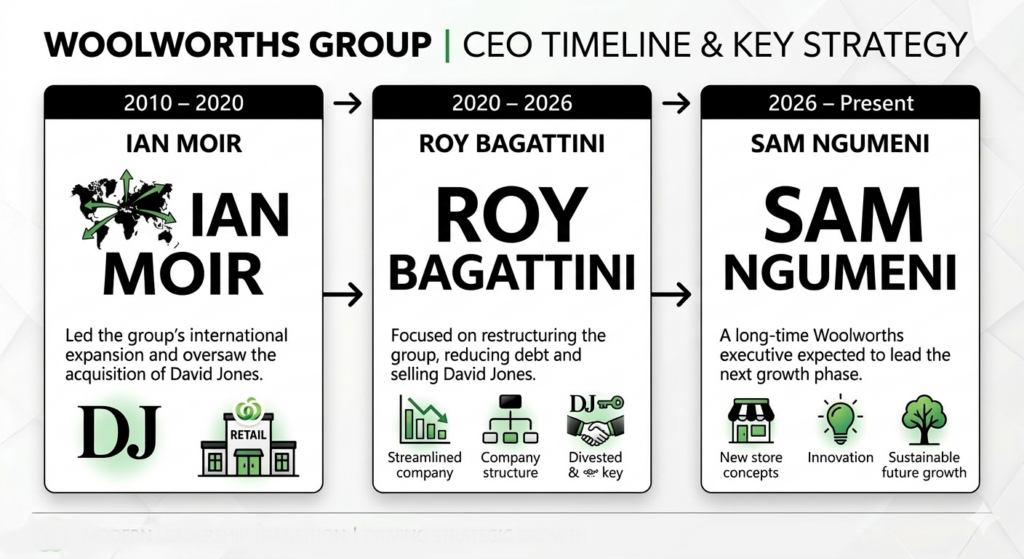
Ngumeni will take over from Bagattini, who succeeded Ian Moir in 2020. Moir, a Scottish retail executive, had led the company since 2010 and oversaw a period of major international expansion, including the acquisition of David Jones.
Woolworths CEO Timeline
2010 – 2020
Ian Moir
Led the group’s international expansion and oversaw the acquisition of David Jones.
2020 – 2026
Roy Bagattini
Focused on restructuring the group, reducing debt and selling David Jones.
2026 – Present
Sam Ngumeni
A long-time Woolworths executive expected to lead the next growth phase.
For investors and analysts, the shift from an externally recruited global executive to a long-time Woolworths insider could signal a strategic pivot – one focused on operational depth and internal brand understanding rather than international expansion.
The apparel gap
By contrast, the Fashion, Beauty and Home (FBH) division has struggled to match the momentum of the food business.
Apparel growth has been uneven, reflecting both internal restructuring and broader macroeconomic pressures on discretionary spending. Several reporting periods during Bagattini’s tenure showed the clothing business lagging behind food in both revenue growth and profitability.
The divergence has become a defining narrative for Woolworths: a retailer widely praised for its premium food offering but still searching for consistent growth in apparel.
The Australian challenge
A significant portion of the pressure on Woolworths’ fashion business has stemmed from its Australian operations.
Through Country Road Group – which includes brands such as Country Road, Witchery and Trenery – the group maintains a sizeable presence in the Australian apparel market.
However, recent financial results have revealed the challenges facing the segment. Sales have softened amid discounting pressures and weaker consumer demand, while profitability has been squeezed by restructuring costs and brand impairments. The Australian market’s reliance on discretionary spending – combined with high interest rates and currency volatility – has compounded the challenge.
For Woolworths, these headwinds have frequently overshadowed improvements in its South African fashion operations.
A repositioning in progress
Bagattini’s response has been to reset the fundamentals of the apparel business. Over the past few years, Woolworths has closed underperforming stores, reduced discounting and focused on increasing the proportion of merchandise sold at full price – a key indicator of brand strength. The company has also experimented with new retail concepts, including smaller clothing formats and curated fashion concepts through its Ventures division.
Still, these initiatives remain relatively small compared with the scale of the core apparel division.
The broader structural question persists: can Woolworths’ fashion business achieve the same premium positioning and consistent performance that defines its food offering?
A new leadership chapter
As Bagattini prepares to hand leadership to Ngumeni, Woolworths enters a new phase focused less on restructuring and more on unlocking growth. Ngumeni’s deep operational experience inside the company – particularly within its strongest performing division – positions him uniquely to address one of Woolworths’ most persistent challenges.
If the group’s food business represents the benchmark for premium retail execution in South Africa, the next chapter may depend on whether its fashion arm can finally close the gap.
The question facing the next leadership era is therefore clear:
Can Woolworths transform its clothing division into a growth engine – or will fashion remain the retailer’s most persistent strategic puzzle?