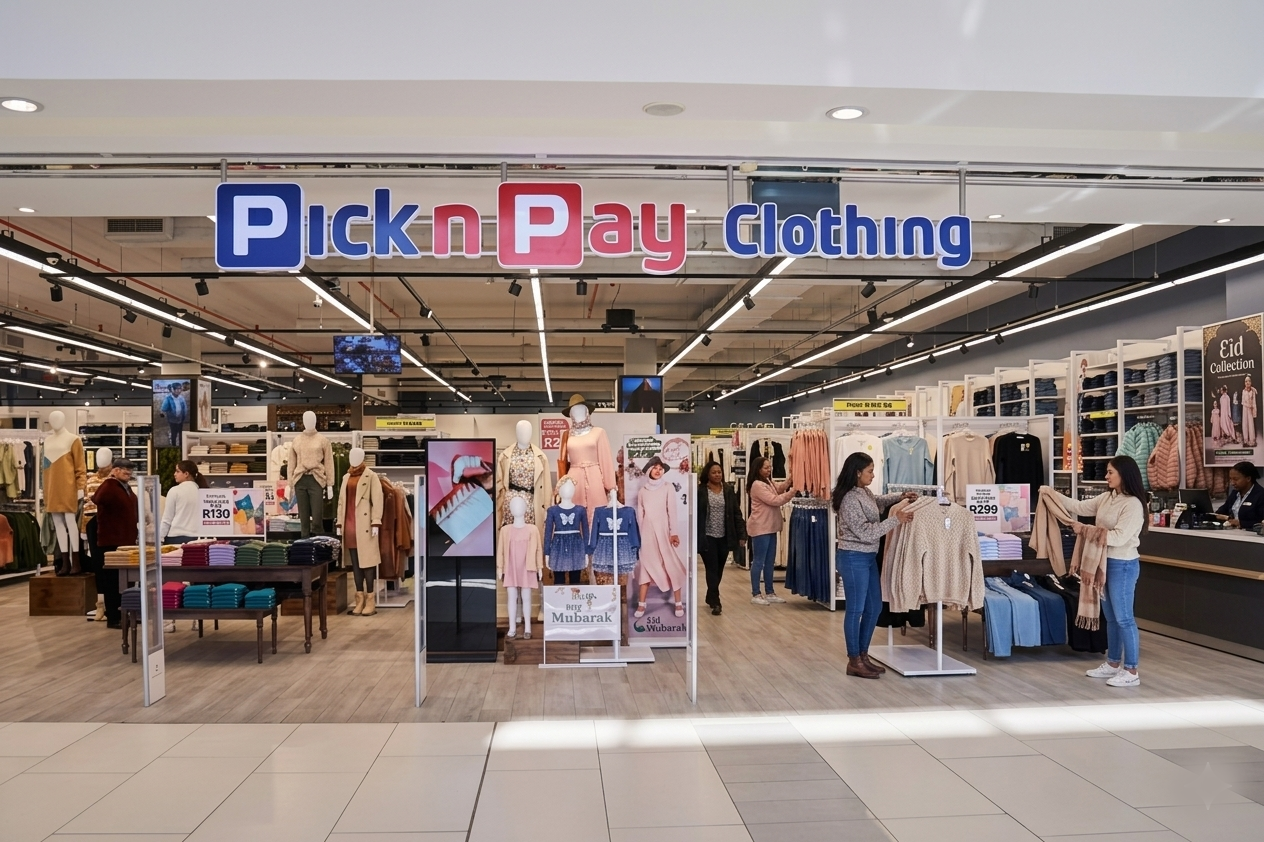
As global e-commerce surges past $6 trillion and South African online retail hits record growth, Pick n Pay has made its boldest digital move yet – and left its biggest competitor with a gap it hasn’t filled.
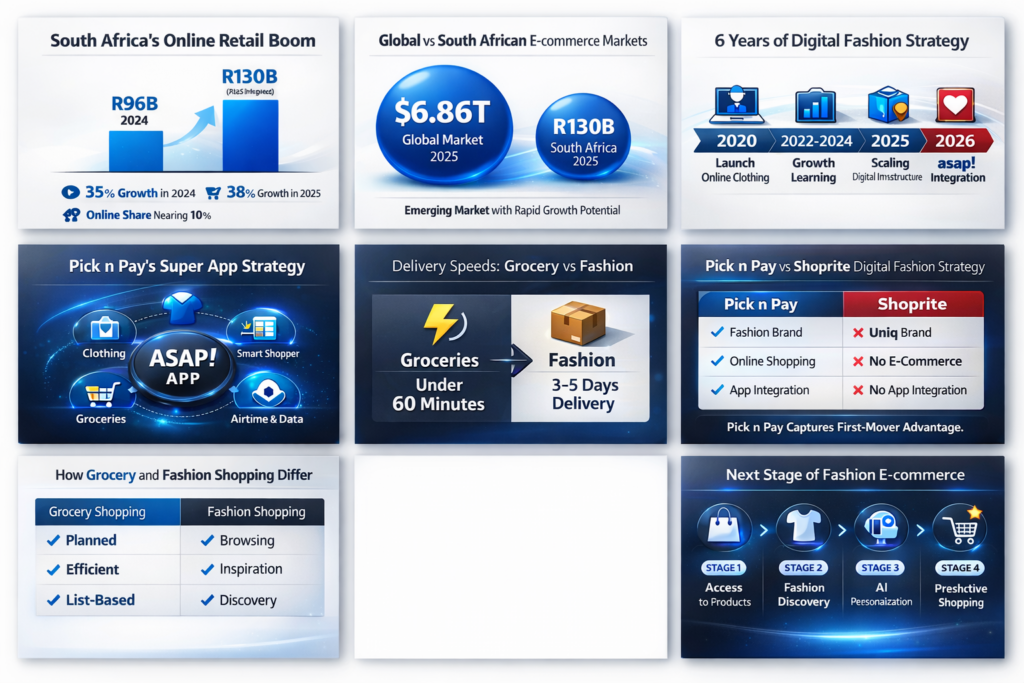
E-commerce is no longer a growth story – it is the story. Global online retail is on track to surpass $6.86 trillion in 2025, expanding at more than twice the pace of physical retail. In South Africa, the numbers are equally difficult to ignore: online retail grew 35 percent in 2024 to reach R96 billion, representing 8 percent of total retail sales in the country. Growth has continued into 2025 at an annualised rate of 38 percent, with the market projected to exceed R130 billion by year end – pushing online’s share of total South African retail toward 10 percent. These are not marginal numbers. They are structural signals. And South African retailers are being forced to reckon with them.
Pick n Pay just made one of the most consequential moves in that reckoning. On 2 March 2026, the retailer officially integrated its full clothing range into the asap! app – the same platform South Africans already use to order groceries in under an hour. Shoppers can now add a jacket to the same basket as their weekend groceries, check out once, and move on. No second platform. No separate account. One ecosystem.
The logic behind the move is familiar to anyone who has watched Amazon or Walmart operate over the past decade: consolidate daily consumer behaviour inside a single platform, raise the switching cost with every additional service, and let the data compound. The execution, however, is distinctly South African in its ambition – and the timing is sharper than it might appear.
Six Years of Groundwork
To understand what happened on 2 March, you have to go back to 2020. While the retail industry’s attention was almost entirely consumed by the grocery delivery arms race – Checkers Sixty60 launching, Pick n Pay asap! responding, the two trading blows on speed and coverage – Pick n Pay was quietly doing something else entirely. It launched a standalone e-commerce store for its clothing range. No fanfare. No major campaign. Just a digital shelf, stocked and open.
For six years, Pick n Pay Clothing built its online presence from that foundation. Year-on-year digital growth became a consistent feature of the category – steady, if unspectacular. The business was learning what sold online, who its digital customer was, how to fulfil fashion orders at scale, and how to manage returns without cannibalising the physical store network.
The asap! integration, then, is not a pivot. It is not a retailer desperately chasing a digital trend it missed. It is a deliberate scaling move – taking a business that already had digital traction and embedding it inside the company’s most powerful consumer-facing channel. That distinction matters for how investors and analysts should read this moment.
What the Integration Actually Means for Shoppers
In practical terms, the experience is straightforward. Customers open the asap! app, browse the clothing range alongside their grocery options, add items to the same cart, and check out once. There is no separate login, no new account to create, no platform switching. For the millions of South Africans who already use asap! for grocery delivery, access to Pick n Pay Clothing is now a scroll away.
But there is a critical detail every shopper needs to understand – and one that Pick n Pay must communicate clearly if the integration is to avoid confusion. Clothing will not arrive in 60 minutes. Fashion items will be delivered nationwide within 3 to 5 working days, a timeline that reflects the fundamentally different logistics of apparel fulfilment versus groceries dispatched from a nearby dark store.
The asap! name is not incidental. It is a brand built on a single, concrete value proposition: immediacy. Grocery delivery in under an hour has been the platform’s entire identity since launch. Expanding that brand to cover a 3-to-5-day fashion delivery window is a meaningful stretch – not necessarily a wrong one, but a stretch that requires careful framing. If customers open the app expecting everything to arrive within the hour and leave disappointed when their clothing order confirmation shows a multi-day window, the integration risks undermining the very equity that made asap! valuable in the first place.
Done well, however, the combined experience could be genuinely compelling: complete your weekly grocery shop, add a few clothing items to the same basket, check out once, and receive your groceries before dinner and your outfit by the end of the week. That is a meaningfully more convenient experience than any single-category app currently offers in South Africa.
The Competitive Gap Pick n Pay Is Exploiting
To understand the strategic significance of Pick n Pay’s move, it helps to look at what its most formidable competitor has, and has not -done.
Shoprite Holdings operates Checkers Sixty60, the dominant grocery delivery platform in South Africa. The service has built strong consumer habits around speed and convenience, with delivery often arriving in under an hour. By most measures, Sixty60 remains the market leader in the country’s grocery delivery race.
In 2023, Shoprite introduced Uniq, its in-house fashion label positioned as an affordable clothing offering. The brand was launched through dedicated standalone retail stores, rather than being integrated into existing supermarket environments. The move marked Shoprite’s entry into a more focused fashion retail strategy.
Three years later, however, Uniq does not yet have an integrated e-commerce channel. Customers are currently unable to purchase Uniq products through the Sixty60 platform, and the brand does not operate a dedicated digital shopping app.
This creates a notable contrast with Pick n Pay, which has spent the past several years building the digital foundations for its clothing category. By integrating its fashion offering into the Pick n Pay asap! app, the retailer is bringing apparel into a platform already used by millions of customers for weekly grocery purchases.
The strategic implication is straightforward. While Shoprite has established a strong presence in fast grocery delivery, Pick n Pay is moving to extend its digital platform across multiple retail categories, allowing clothing to be purchased within the same ecosystem as everyday essentials.
In a South African online retail market expanding at roughly 38 percent annually, the ability to capture multi-category digital transactions could become an increasingly important competitive advantage.
Pick n Pay has spotted that gap and moved to occupy it before Shoprite closes it. By embedding clothing inside the asap! app – with six years of digital fashion retail experience behind it – the retailer gains a first-mover advantage in multi-category digital retail that will be difficult for a competitor to replicate quickly. Building the technology, the fulfillment infrastructure, the product catalogue, and the consumer habit around a new digital fashion channel takes time. Pick n Pay has already spent that time.
Building a Super App: The Bigger Strategic Bet.
Step back from the fashion-versus-groceries framing, and what Pick n Pay is building becomes clearer. The asap! app now spans four distinct consumer verticals: grocery delivery, fashion retail, Smart Shopper loyalty rewards, and value-added services including airtime and data purchases. That is the architecture of a super app – a single platform designed to be present for as much of a consumer’s daily commerce behaviour as possible.
The value of this model compounds with scale. Every additional category that a consumer manages within a single platform raises the cost of leaving it. The data generated by cross-category behaviour – what a customer buys, when they buy it, how often groceries and clothing purchases occur in the same session – becomes increasingly valuable for personalisation, targeted promotions, and anticipating demand. A retailer that knows you buy groceries on Thursday evenings and replace your running kit every six months has a fundamentally different relationship with you than one that only knows which cereal you prefer.
Amazon understood this years before most retailers were willing to admit it. Walmart has been executing the same playbook in the United States with increasing sophistication. In the South African context, Pick n Pay is applying the same logic to a market that is growing fast enough to reward exactly this kind of ecosystem investment right now.
Where the Strategy Has Further to Go
The integration is a strong first step. But fashion e-commerce operates by rules that grocery delivery does not, and Pick n Pay will need to reckon with them if the clothing category is to reach its potential within the asap! platform.
When a consumer opens a grocery app, they have a list. They know what they need. The experience is transactional by design, and efficiency is the primary value. When a consumer browses fashion, the dynamic is entirely different. They are often not on a mission at all – they are exploring. Discovery, inspiration, and curation are the mechanisms that drive conversion in clothing retail, and they require a fundamentally different kind of user experience from the one that works for a weekly grocery shop.
Zara, ASOS, and Shein have each built dominant fashion e-commerce businesses not primarily on convenience, but on experience – personalised feeds, visual curation, AI-assisted styling recommendations, and frictionless returns that make the risk of buying something without trying it first feel manageable. Those capabilities are increasingly not differentiators in fashion e-commerce. They are the baseline expectation.
The current asap! integration prioritises access – getting Pick n Pay Clothing in front of millions of existing grocery app users. That is the right starting point, and it addresses the most immediate opportunity. But if Pick n Pay intends to build an engaging digital fashion business – not just a convenient add-on to the grocery experience – the next investment will need to be in the experience layer: personalised recommendations that understand individual style preferences, curated outfit edits that inspire rather than just list products, seamless returns that remove hesitation at the point of purchase, and eventually the kind of AI-assisted styling tools that are beginning to separate the most sophisticated fashion platforms from the rest.
The infrastructure is in place. The audience is assembled. What comes next is making the experience feel designed for fashion, not retrofitted from groceries.
The Bigger Signal
Zoom out far enough, and this integration is a data point in a much larger story about what retail is becoming in South Africa. The category boundaries that defined the industry for decades – supermarket versus clothing store versus online marketplace versus delivery platform – are dissolving. The consumer does not think in those categories anymore, and increasingly, neither do the most capable retailers.
Online retail in South Africa is growing at 38 percent annually and is on course to represent 10 percent of all retail sales by the end of 2025. The platforms that capture that growth will not simply be the ones with the best products or the most stores. They will be the ones that own the most of a consumer’s daily commerce life – present at every point in the decision-making process, from the grocery shop to the wardrobe refresh, to the loyalty redemption.